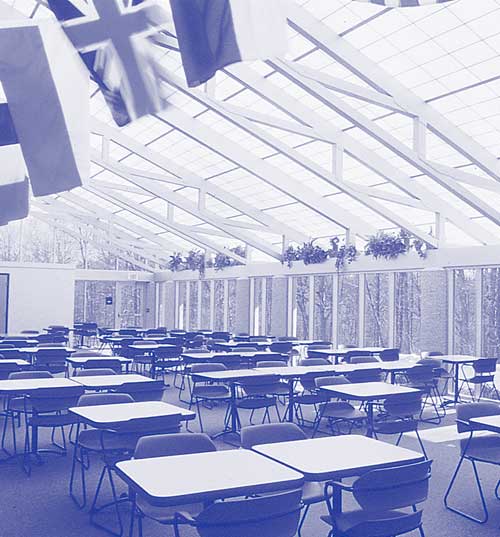

Overview of…
Note 46. Daylighting Design
This Note outlines the key steps in designing good daylighting. It provides a firm introduction to this challenging topic and provides background for the energy conservation measures of the Energy Efficiency Manual that include daylighting.
Three separate subject areas must be mastered to achieve successful daylighting: (1) the human factors of illumination requirements and visual comfort, (2) coordinating daylighting with artificial lighting, and (3) integrating daylighting with the heating and cooling of the building.
Visual quality is the prime factor. The Note explains that daylighting should have an acceptable range of intensity, it should avoid excess brightness or glare within the visual field, and it should be oriented in the appropriate direction for the illumination required. It is essential to avoid visual desensitization, or blinding by excessive light intensity. People are not forgiving about large variations of brightness within their space. If daylighting causes strong contrasts in illumination, occupants invariably turn on all the electric lights in an attempt to match the illumination levels provided by the daylighting.
Electric lighting must be coordinated with daylighting effectively, so that it is not wasted when daylighting is available. In addition, the electric lighting controls must respond to other variables, such as the occupancy of the spaces, the types of activities being conducted, and individual needs and preferences.
It is essential to avoid increased air conditioning cost, or else the savings in lighting energy will be cancelled by increased cooling load. For maximum efficiency, daylighting should use as little glazing area as possible.
Daylighting design is complicated by the fact that most climates require both heating and cooling. This makes it imperative to integrate daylighting with passive solar heating, where it is used.
Click here to return to the Table of Contents