Overview of…
Note 33. Absorption Cooling
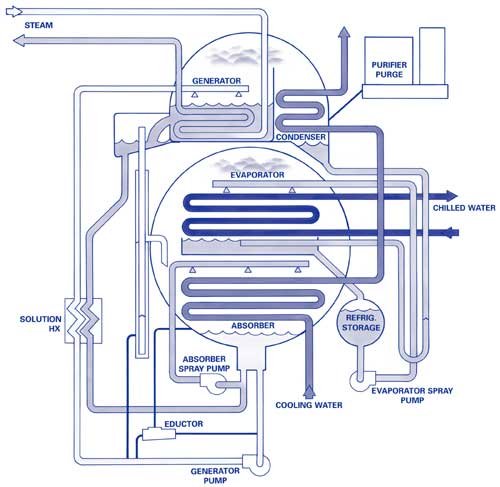
Many of the energy conservation measures of the Energy Efficiency Manual apply to cooling systems that use absorption chillers. This Note gives you a solid introduction to absorption cooling systems and absorption chillers, emphasizing the aspects of design and equipment selection that affect system efficiency. Using dramatic illustrations, the Note explains the principle of absorption cooling and the components of absorption chillers.
The distinguishing characteristic of absorption cooling equipment is that it produces cooling by using heat energy as an input, rather than by using mechanical energy. For this reason, absorption chillers were once common in facilities that had large boiler plants with excess capacity during the cooling season. Unfortunately, absorption cooling is inefficient, and absorption chillers appeared destined for extinction. However, new circumstances are giving absorption chillers a revival.
The components of an absorption chiller must be integrated much more closely than the components of a compression cooling system. As a result, all absorption chillers are contained within a single compact package. For the same reason, absorption chillers have few variations. In all large absorption systems, cooling is distributed by chilled water. Similarly, all condensers are cooled by water, usually from a cooling tower.
In large absorption machines, the actual refrigerant is water at very low pressure. An absorber, usually the salt lithium bromide, is used to move water vapor through the system. Crystallization of the salt is a major operating problem that the design of an absorption chiller seeks to avoid.
The main differences between models are in the heat source and in the number of stages. Originally, the energy source for absorption chillers was steam or high-temperature hot water. Presently, direct firing using an integral boiler is gaining popularity because of its greater efficiency. Older absorption machines were single-stage machines. However, they are being supplanted by two-stage machines, which provide substantially higher efficiency. Virtually all direct-fired absorption machines are two-stage.
This Note also explains the effect of condenser water temperature and chilled water temperature on efficiency. Also, you will learn the design features used to improve part-load efficiency. The Note provides a comparison between absorption and compression cooling. It concludes with a summary of hybrid chiller systems, which seek to offset the low inherent efficiency of absorption machines.
Click here to return to the Table of Contents