Overview of…
4.7 Variable-Air-Volume Single-Duct Systems
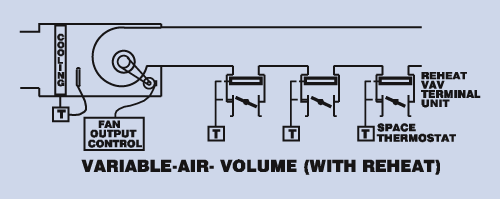
This part of the Energy Efficiency Manual shows you how to save energy in variable air volume (VAV) air handling systems. In VAV systems, chilled air is distributed to spaces from an air handling unit, and the temperature of individual spaces is controlled by throttling the quantity of air into each space. The throttling is accomplished by terminal units that are controlled by the space thermostats.
VAV systems were originally introduced as a more efficient alternative to constant-volume reheat systems. The VAV concept offers two major efficiency improvements: (1) it reduces or eliminates reheat and (2) it minimizes fan power. Unfortunately, the full efficiency potential of many VAV systems has not been achieved in practice. In many systems, the terminal units contain reheating coils. These are used to provide space heating, or to reheat the chilled air to allow a minimum air flow to be maintained in the spaces, or for both purposes.
As VAV systems became widespread during the 1980’s, it became apparent that they incur a number of conflicts with comfort and air quality. Indeed, VAV has become notorious for its comfort problems. Attempts to resolve the comfort problems and to reduce the installation cost of the systems often resulted in systems that squandered much of the efficiency potential of the VAV concept.
By far the largest opportunity for energy conservation in VAV reheat systems is minimizing the operation of the reheat coils. Also, you can save both reheat energy and fan energy by using accurate fan modulation to match cooling or heating load changes.
Here are the energy conservation measures for optimizing the efficiency of VAV systems, with particular attention to reducing their comfort and ventilation problems. These include reducing reheat losses by adjusting the discharge temperature of the cooling coil automatically with supply air temperature reset controls. You will also learn to install changeover controls that can completely eliminate reheat for much of the time.
VAV systems also allow you to use energy saving thermostatic controls, including deadband thermostats and temperature setback thermostats.
Click here to return to the Table of Contents