Questions & Answers
What is the Energy Efficiency Manual?
The Energy Efficiency Manual is the world’s primary reference and how-to guide for energy conservation and reducing utility costs.
What topics does it cover?
It shows you how to save energy and reduce your utilities costs in every kind of business, institution, manufacturing plant, and housing. The main sections cover heating, cooling, water systems, building insulation, air leakage, lighting, sunlight, and common industrial equipment. Conventional energy sources, renewable resources, free energy sources, and water resources are covered in detail. Click Table of Contents to see the main subject areas. Click Index to search every topic in the book.
Who uses it?
The Energy Efficiency Manual is for everyone who is interested in energy conservation and protecting the environment. People from all walks of life use it and enjoy it.Architects and engineers use it to design efficient, healthy buildings and plants. Property managers and plant operators use it to reduce their utility costs, to solve comfort problems, and to increase equipment reliability. Property owners and administrators use it as a financial tool to manage utility costs. Energy auditors, public utilities, and energy service providers use it to provide the best service to their customers. Government agencies and code officials use it to understand conservation laws.
Students use it as a textbook in energy management courses and as a guide to environmental projects. Faculty and writers use it as a complete sourcebook.
Homeowners have used it to select efficient appliances, improve windows and insulation, save water, and make other improvements. However, homeowners should now use our new book, Super House, which specifically relates to all aspects of energy efficiency in residential homes. Click here to learn more about Super House.
How big is the Energy Efficiency Manual?
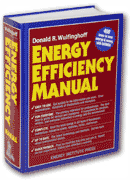
It is the most complete book on energy efficiency. It has 1,536 pages. It is three inches thick, with a hard cover. It weighs over eight pounds, but it requires no batteries or external power, and you can read it even in bright sunlight!
Does it have illustrations?
Yes. It has 830 illustrations, including about 700 photographs of actual equipment and installations. Realistic diagrams make the most advanced energy systems easy to understand. Every illustration is captioned to highlight the important points. Click Look Inside the Book to select actual pages for viewing.
Is it for designing new buildings or for improving existing facilities?
Both. Also, it shows how to improve your daily operation and maintenance activities.
Is it easy to use?
Yes. The Energy Efficiency Manual is designed for everyone. Non-technical readers find it easy to understand, while experts get the detail they want. It is written in conversational style. Each subject starts with the basics. It has many features that lead you quickly to the best efficiency improvements for your building, facility, or plant. It shows you actual equipment and methods, and gives you hundreds of real-world examples.
How technical is it?
Some areas of energy efficiency are simple, and others require a great deal of specialized knowledge. The Energy Efficiency Manual lets you master them all. The style is informal and easy to read. Every term is explained.
How is the Energy Efficiency Manual organized?
It has two complementary parts, the Measures and the Reference Notes. The first part of the Energy Efficiency Manual is organized as a how-to manual, with 400 activities called “Measures.” Each Measure is a self-contained method of improving efficiency in your existing building or business, or an efficient design feature for new facilities, or a method of operating your facility more efficiently. To view typical Measures, click The Measures. The Measures are grouped logically in Sections and Subsections to help you organize your energy conservation program. Click Table of Contents to see them.The second part of the book, called “Reference Notes,” explains the important topics of energy conservation. You can read the Reference Notes in any order, without referring to the Measures. To see typical Reference Notes, click Reference Notes. To see the complete listing of Reference Notes, click Table of Contents.
Does the Energy Efficiency Manual use a lot of mathematics?
No. It doesn’t let math get in the way of understanding. It is not cluttered with formulas and tables that are readily available elsewhere. Where conservation activities require engineering calculations, the Manual identifies the appropriate references. A few simple formulas are provided for convenience.
Does it provide information about costs?
Yes. Each of the 400 Measures includes “Economics” that estimate the energy saving, the payback period, and the cost of accomplishing the activity.
How much does the book cost?
$199.95.
Is it worthwhile for me to buy it?
If you are responsible for utilities costing a few thousand dollars or more each year, the Energy Efficiency Manual will probably pay for itself the first time you use it. Almost every building, housing complex, farm, and factory has major opportunities for saving energy and water costs. If you are a manager, provide a copy to everyone who influences your energy costs. For less than many organizations spend for energy in one hour, you can equip every key person with this powerful tool for reducing your high energy costs.
How can I be sure that our energy conservation activities will really pay off?
By knowing what you are doing. The Energy Efficiency Manual gives you the information you need to accomplish your activities successfully. Each Measure has “Ratings” and a “Selection Scorecard” to help you select the combination of activities that is most profitable for your situation. Each Measure has “Traps & Tricks” that show you how to avoid pitfalls and keep your energy conserving features working successfully.The Energy Efficiency Manual is candid about controversial issues. For example, which “renewable” resources are not environmentally friendly? What are the motives of utility companies in promoting conservation? The Manual debunks conservation gimmicks, and warns you away from bad quality in some popular products, such as screw-in fluorescent lamps.
How does the Energy Efficiency Manual deal with environmental issues?
The Energy Efficiency Manual is the one complete guide to energy conservation in the commercial, industrial, and residential sectors. These sectors account for two thirds of the world’s energy consumption. With this consumption comes a host of environmental dangers. Burning fossil fuels pumps carbon dioxide into the atmosphere, accelerating the greenhouse effect. Air conditioning systems release gases that deplete the earth’s ozone layer. Discarded lamps contribute to mercury pollution. Fuels themselves are an important resource that is being depleted. Using energy efficiently is the most direct way to reduce these problems.The Energy Efficiency Manual stresses comfort, health, and safety. For example, the Measures that improve the efficiency of air conditioning systems tell you how to avoid health hazards associated with these systems, such as Legionnaires’ Disease and “sick building syndrome.”